October 2026
October is World Pet Obesity Month
Check your pet’s body condition, take part in APOP’s research, and find pet-first guidance for conversations about weight and health. Both 2026 surveys stay open through December 31.
Explore World Pet Obesity Month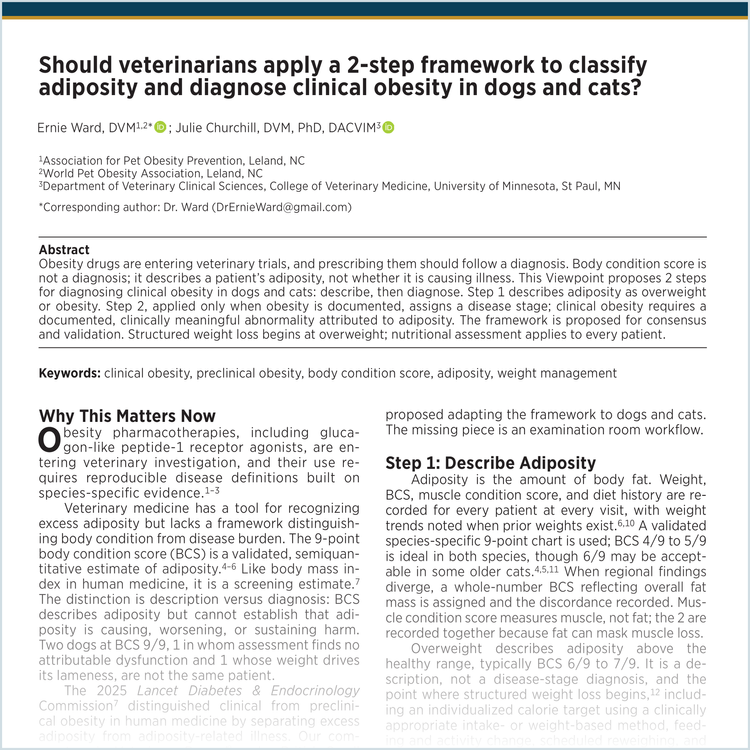
New in JAVMA
Open access · October 7, 2026A 2-step framework to diagnose clinical obesity in dogs and cats
A body condition score shows how much fat a pet carries, not whether that fat is causing harm. A new peer-reviewed Viewpoint by Ernie Ward and Julie Churchill separates the two: classify adiposity first, then use the Three A’s to diagnose clinical obesity.
Ward E, Churchill JA · J Am Vet Med Assoc · doi.org/10.2460/javma.26.06.0499
The framework page is hosted at worldpetobesity.org by the World Pet Obesity Association, a separate organization also founded by Dr. Ward.
Now Available
2026 Pet Obesity Communication Guidelines
Practical, pet-first guidance for clearer conversations about body condition, excess weight, and obesity in veterinary care and public communication.
Explore the Communication Guidelines- Pet-first
- Clinically clear
- Consistent language
Resources & tools
Practical help for pets and the people who care for them
Start with a resource hub or go directly to a frequently used APOP tool.
Pet Owner Resources
Body condition, feeding, calories, treats, healthy-weight guidance, and practical next steps.
Explore owner resourcesBody & muscle condition
Dog, cat, rabbit, and horse BCS charts, plus the dog and cat Muscle Condition Score chart.
View BCS & MCS chartsDog & cat calorie tools
Estimate daily needs, feeding amounts, current intake, and treat calories.
Choose a calculatorHow to read a pet food label
Find calories, feeding directions, nutritional adequacy, and the label details that matter.
Explore the label guide2026 Surveys
Take part in APOP's 2026 research
Help APOP measure body condition in dogs and cats, or share your views on pet weight and nutrition. Choose the survey for you.
2026 Prevalence Survey
Choose a day, two days, or one week to record eligible dogs and cats. Qualifying U.S. clinics receive a $50 staff-time stipend after at least 15 complete, eligible records pass review.
Pet Obesity & Nutrition Opinion Survey
Share your perspective on pet body condition, feeding, weight management, nutrition, and veterinary communication.
Stay informed
Get APOP updates
Receive new tools, survey deadlines, research findings, and practical guidance for pet owners and veterinary teams.