APOP
Articles & News
News, research, commentary, and practical guidance on pet obesity, nutrition, and healthy weight.
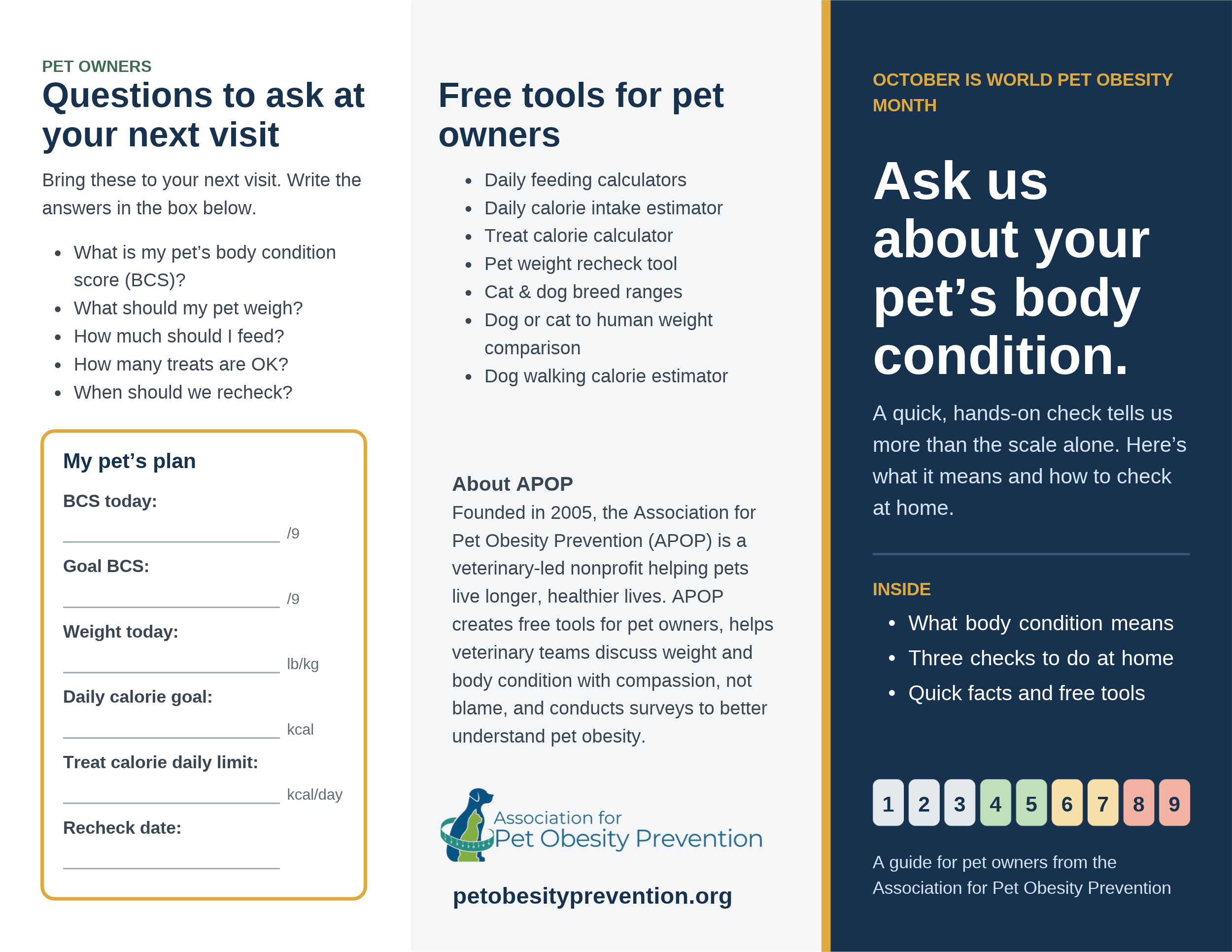
World Pet Obesity Month 2026: Research and Tools for Pet Owners
World Pet Obesity Month is a chance to check your pet’s body condition and start a conversation with your veterinary team. Explore APOP’s free quiz, feeding and weight tools, downloadable guide and 2026 Opinion Survey.
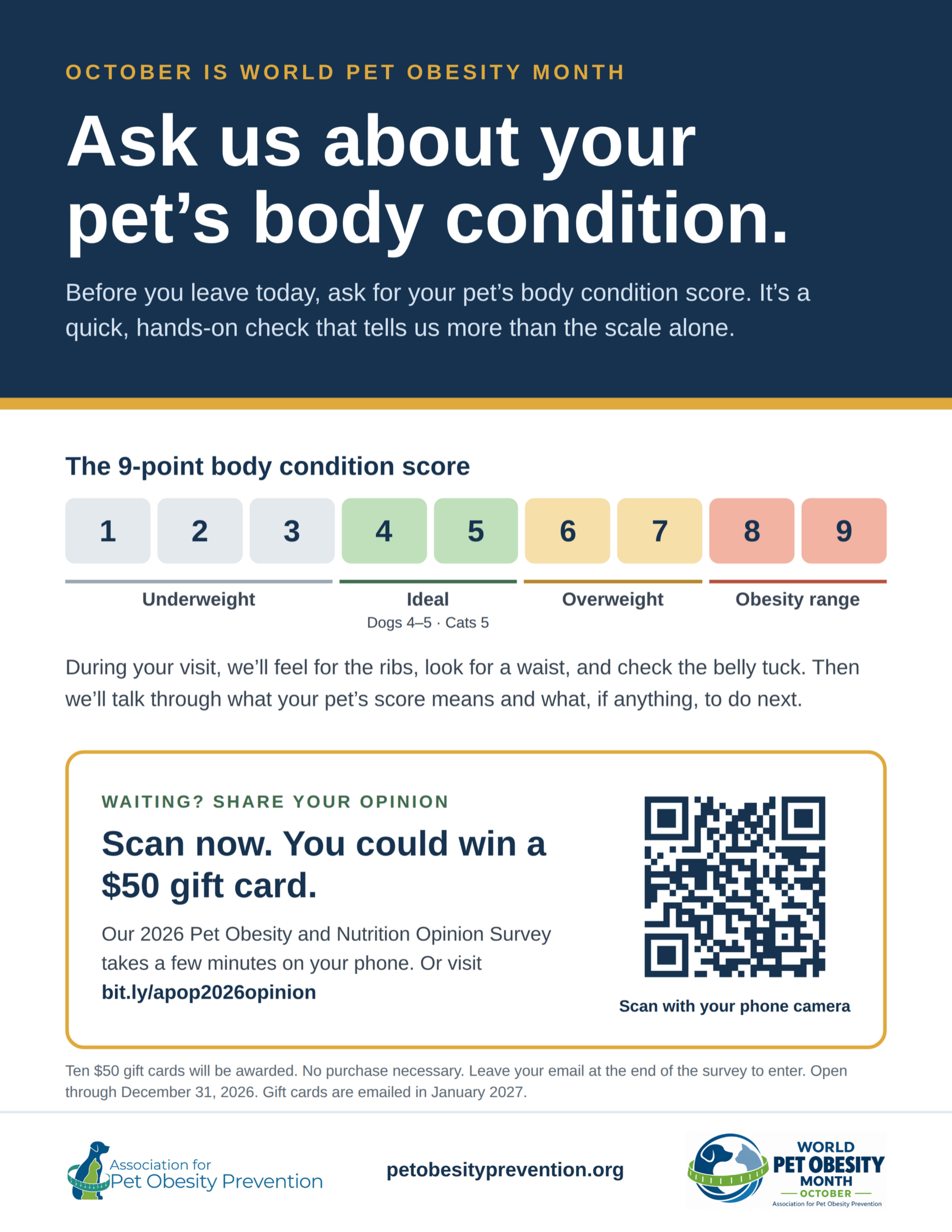
APOP Veterinary Update | October 2026
World Pet Obesity Month 2026 brings research opportunities and updated resources for veterinary teams. Join APOP’s Pet Obesity Prevalence Survey, explore interactive Communication Guidelines and clinical calculators, and share your perspective in the annual Opinion Survey. Both surveys remain open through December 31, 2026.
Press Release: World Pet Obesity Month Puts Pets First With New Communication Guidelines
APOP has released its 2026 Pet Obesity Communication Guidelines, introducing four standardized terms for describing a pet’s weight status. The release also marks the start of World Pet Obesity Month and the 2026 Pet Obesity Prevalence Survey for veterinary clinics.
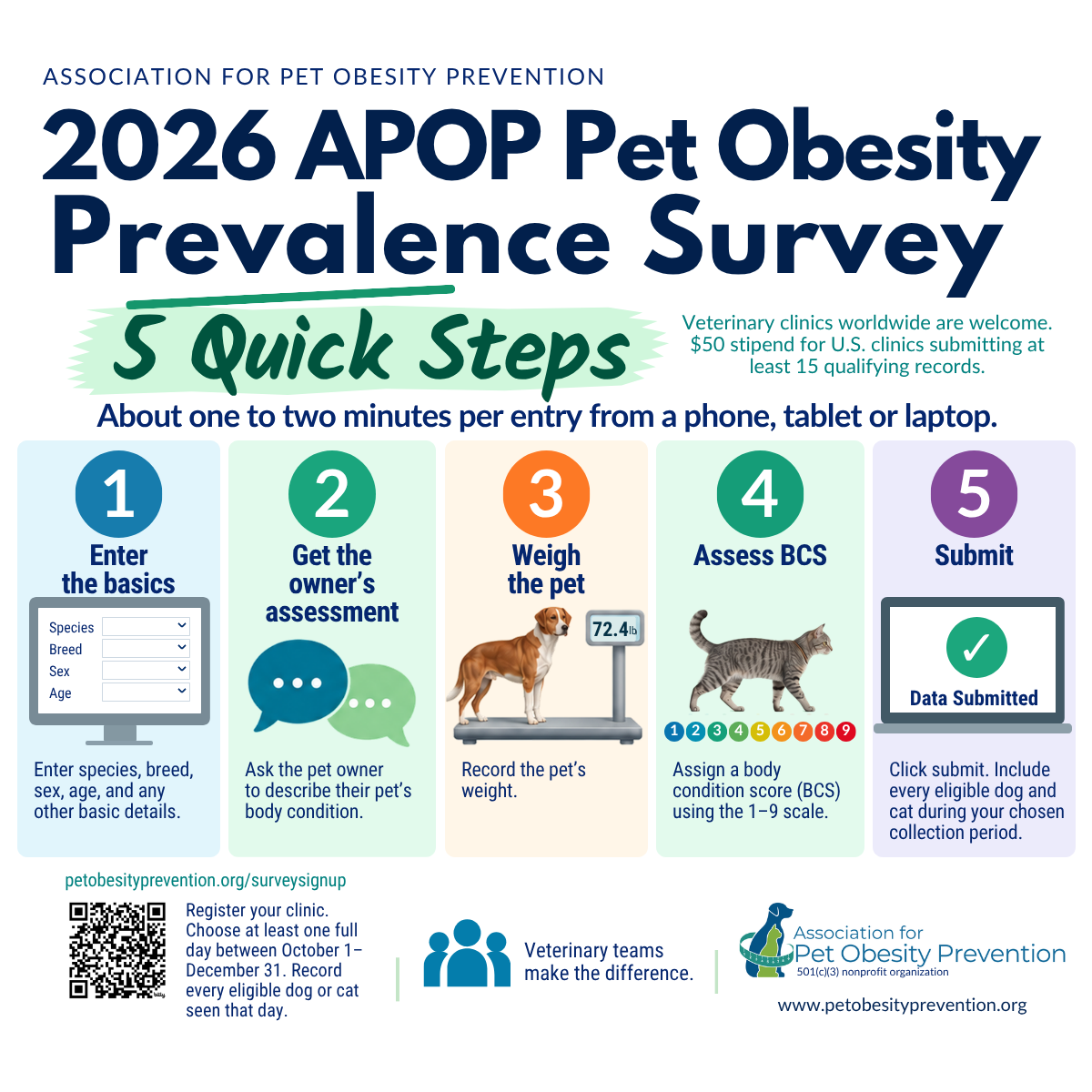
Newsletter One clinic day.That’s all we’re asking.
APOP is asking veterinary clinics to give one day to the 2026 Pet Obesity Prevalence Survey and inviting pet owners and veterinary professionals to share their perspectives in the annual Pet Obesity and Nutrition Opinion Survey. Qualifying U.S. clinics can receive a $50 stipend for participating.
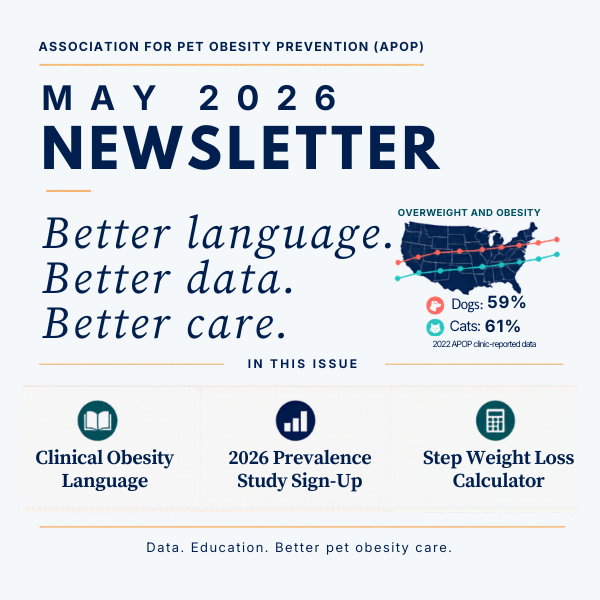
Better Language, Better Data, Better Pet Obesity Care | APOP
The latest APOP newsletter highlights why language matters in diagnosing clinical obesity, introduces the updated Step Weight Loss Calculator, and invites veterinary teams and universities to join the 2026 Pet Obesity Prevalence Study.

Health Connects Us All: Preparing for the 2026 Global Prevalence Study
Sign up is now open for the 2026 Pet Obesity Prevalence Survey. As a designated prevalence study year, October 2026 will move beyond awareness to standardized data collection, practice-level reporting, and a clearer understanding of clinical obesity trends in dogs and cats across regions and care settings.

APOP December Update: GLP-1 Research in Pets and the 2025 Obesity Survey
APOP’s December update reflects on 20 years of progress in clinical obesity recognition, highlights emerging GLP-1 research in companion animals, and invites participation in the 2025 Pet Obesity & Nutrition Opinion Survey.
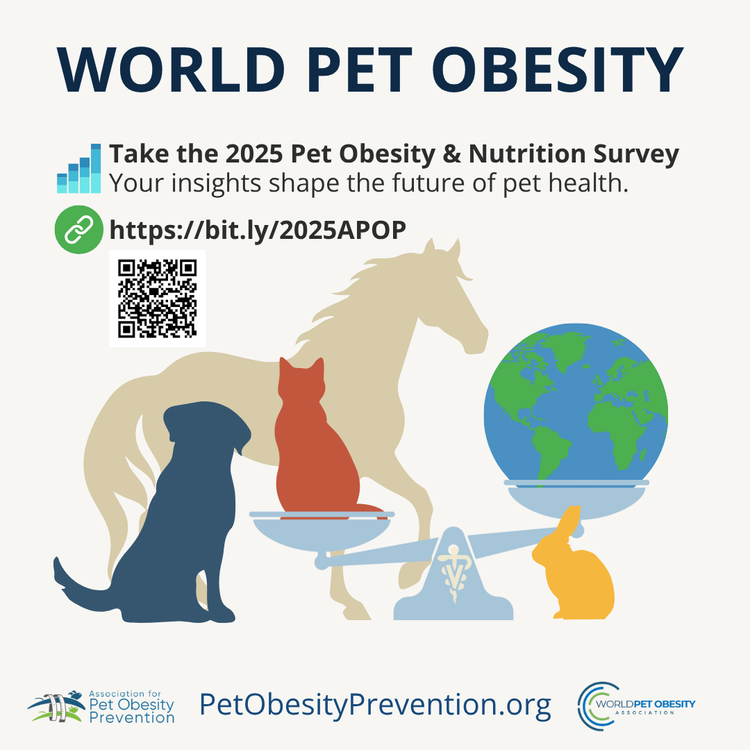
World Pet Obesity Week 2025: Survey, Tools & Global Initiative
World Pet Obesity Week 2025 highlights clinical obesity awareness, the 2025 Pet Obesity Survey, and global tools supporting veterinary teams.

Treat Obesity in Pets to Improve Liver Health
What we’ve long suspected is now official: the FDA just approved a weight-loss drug to treat liver disease.
On August 15, 2025, the US Food and Drug Administration (FDA) granted accelerated approval for semaglutide (Wegovy) to treat metabolic dysfunction-associated steatohepatitis (MASH) with moderate to advanced fibrosis in adults (FDA, 2025). That decision does more than add another indication for a familiar drug. It reframes obesity therapy as liver therapy, raising a practical question for veterinary teams and the industry: if treating obesity improves liver outcomes in humans, how should we monitor and communicate liver outcomes in dogs and cats?

APOP Congratulates Dr. Julie Churchill, 2025 dvm360® Veterinary Heroes Honoree in Nutrition
The Association for Pet Obesity Prevention (APOP) proudly congratulates Executive Board member Julie A. Churchill, DVM, PhD, DACVIM (Nutrition), on being named the 2025 dvm360® Veterinary Heroes honoree in the Nutrition category.
The Veterinary Heroes Awards recognize peer‑nominated professionals for leadership, compassion, and lasting impact on animal health. Winners were celebrated during a luncheon at the Fetch dvm360 Conference in Kansas City, Missouri.

What’s Weighing Us Down: Study Uncovers Implicit Bias in Veterinary Obesity Care
Obesity is one of the most common and debilitating chronic diseases in dogs and cats today. You’d think that means we’re pretty good at spotting it, talking about it, and treating it. However, a new study conducted at the Ontario Veterinary College suggests that veterinary professionals may not be as objective as we think when it comes to pet obesity, and our unconscious biases might be part of the reason we’re not doing a better job with our patients and clients.

2024 Survey Reveals Shifts in Pet Obesity Awareness—and Where We Still Fall Short - Press Release
The Association for Pet Obesity Prevention (APOP) has released its 2024 Pet Obesity & Nutrition Opinion Survey results, revealing evolving pet owner awareness and ongoing communication challenges around pet obesity. The survey, which includes responses from over 580 participants, offers a critical pulse on how U.S. pet owners perceive and manage their pets’ body conditions.

Press Release: Hill’s Pet Nutrition and The Association For Pet Obesity Prevention (APOP) Unite to Combat Pet Obesity
"We are proud to collaborate with Hill’s as we work together to advance research on understanding pet obesity bias and promoting evidence-based treatments for obesity," said Dr. Ernie Ward, Founder of the Association for Pet Obesity Prevention. "Hill’s has been a leader in advancing pet health through innovative nutrition and research, and their commitment to addressing the complex communication challenges of pet obesity is truly commendable."

Redefining Obesity in Veterinary Medicine: Making the Case for "Clinical Obesity"
In this article, veterinarian Dr. Ernie Ward explains why 'clinical obesity' is more than just a term—it's a critical tool for enhancing outcomes in our fight against pet obesity

Press Release: Virbac Partners with Association of Pet Obesity Prevention to Increase Awareness, Importance of Pet Nutrition
Virbac, a global leader in animal health, is proud to announce its strategic alliance with the Association for Pet Obesity Prevention (APOP) to confront the escalating health threat of pet obesity in the United States. With an alarming 56% of dogs and 60% of cats classified as overweight or obese, the two organizations recognize the urgent need to address the hormonal and metabolic changes that occur following the spay or neuter procedure pre-disposing pets to obesity and obesity-related illness and health complications, according to veterinary experts.

The Importance of Treating Obesity First
An “obesity first” strategy should be implemented for animals suffering from chronic conditions such as osteoarthritis, insulin resistance, cardiovascular and respiratory conditions, hypertension, and more. In simplest terms, “obesity first” means we treat obesity as a priority when confronting these obesity-associated disorders. By losing excess body fat and increasing lean muscle mass, nearly all of these chronic diseases can improve, and some may even experience remission.

Pet Weight Loss Drugs Are Coming - Maybe Sooner Than You Think
“The Year of Ozempic” proclaimed the December 2023 edition of The New Yorker.
That same month, the journal Science declared glucagon-like peptide-1 (GLP-1) weight loss drugs its “Breakthrough of the Year,” beating out commendable contenders such as new malaria and Alzheimer’s treatments, innovative climate change research on natural carbon pumps and artificial intelligence (AI) in improving weather forecasting. Apparently, Science viewed treating obesity as a bigger story than dementia and global warming.
With all the success of human obesity medications, could pet weight loss drugs be far behind?

How We Should Talk About Obesity in Animals
Veterinary and human healthcare professionals often use the term “obese” to describe a patient with excess body fat. Calling a patient “obese” has significant negative connotations and can be stigmatizing and emotionally triggering.
In veterinary medicine, labeling a pet as “obese” can imply that the owner has failed to provide proper care and nutrition, potentially causing feelings of unease and criticism. It shifts the focus from underlying physiological causes such as genetics, microbiome, hormonal imbalances, and other biological factors to lifestyle choices like exercise and diet.
On the other hand, the proposed terminology, such as “the dog has obesity, ” “a cat having obesity,” or “a pet with obesity,” focuses on the disease state rather than the physical appearance, thereby avoiding blame on the pet owner's actions or an animal’s behavior or inherent characteristic.

Survey Reveals Pet Owners Don’t Recognize Excess Weight, Struggle with Pet Weight Loss, and Give Lots of Dog Treats
A recent study by the Association for Pet Obesity (APOP) sheds light on pet weight concerns in the United States. The 2022 U.S. Pet Obesity Prevalence Survey found a staggering 61% of cats and 59% of dogs are overweight or have obesity, indicating a widespread problem with pet health. However, a survey conducted in Winter 2023 among pet owners and veterinary professionals showed a lack of awareness about this issue. Only 28% of cat owners and 17% of dog owners acknowledged that their pets were overweight, with 84% of dogs and 70% of cat owners assessing their pets’ body condition as healthy.
“Over the past two decades, we have consistently observed a significant discrepancy between the prevalence of pet obesity and pet owners' recognition of this issue,” observed APOP Founder and President. Dr. Ernie Ward. “Pet owners reporting that ‘pet obesity is a problem, but not for my pet’ continues to be a communication hurdle for veterinary professionals. While the causes of obesity in animals are multifactorial, awareness of an unhealthy body condition is the first step in treating the disease.”