Association for Pet Obesity Prevention
APOP Press Kit
Campaign news, research findings, definitions, biographies and images for reporting on body condition and obesity in dogs and cats.
Last updated:
World Pet Obesity Month 2026
October is World Pet Obesity Month, APOP’s campaign to support pet-first conversations about body condition, weight and health. National Pet Obesity Awareness Day falls on Wednesday, October 14, 2026, within the month-long campaign.
Both the 2026 Pet Obesity Prevalence Survey and the 2026 Pet Obesity and Nutrition Opinion Survey continue through December 31, 2026, beyond the October awareness campaign.
Dr. Ernie Ward is available for interviews. For October 2026 media inquiries, APOP aims to respond the same day.
Time zone: Eastern Time, United States.
October 2026 campaign announcement
Current release
APOP Puts Pets First With New Communication Guidelines for World Pet Obesity Month
Free guidelines and tools help pet owners and veterinary teams talk about obesity. Two surveys invite both groups to contribute to research, with clinic participation across the country essential to tracking body condition.
Release dated
Opens in a new tab. Use your browser’s PDF controls to save a copy.
Calculators and practical tools
APOP’s calculator collection supports conversations about food portions, activity, body condition and weight care. These estimates support, rather than replace, individual veterinary guidance.
For pet owners
- Adult Daily Feeding Calculators: Estimate maintenance calories and food portions for healthy, fully grown adult dogs and cats.
- Pet Daily Calorie Intake Estimator: Add up calories from meals, treats and extras. This estimates current intake, not a feeding target.
- Treat Calorie Calculator: See how treats and extras fit into a pet’s daily calorie budget.
- Dog & Cat Breed Weight Ranges: Compare current weight with a typical adult breed range. Breed ranges are general references, not individual ideal-weight targets.
- Dog or Cat to Human Weight Comparison: Put extra weight into a familiar comparison using the dog or cat tool.
- Dog Walking Calorie Estimator: Review a completed walk’s average pace, with approximate calories shown only within supported reference conditions.
- Pet Weight Recheck Tool: Compare weigh-ins to estimate weight change and review when follow-up may be needed.
For veterinary teams
- Veterinary RER/MER Calculator: Estimate resting and maintenance energy requirements from current body weight as a clinical starting reference, not an active weight-loss plan.
- Step-by-Step Weight Loss Planner: Build a structured plan with estimated ideal weight, weight-loss targets and recheck guidance.
- Ideal Body Weight Estimator: Estimate an individual dog’s or cat’s target weight from current weight and body condition score.
Reporters’ quick facts
- Latest published clinic count: In 2022, 59% of dogs and 61% of cats assessed at participating U.S. clinics were in the overweight or obesity BCS ranges. These are body-condition findings, not diagnoses of clinical obesity (2022 findings).
- Body condition awareness: In the 2024 Opinion Survey, 45% of responding dog owners and 40% of responding cat owners reported familiarity with body condition scoring (2024 findings).
- Disease recognition: In the 2025 Opinion Survey, 95% of responding veterinary professionals recognized obesity as a disease (2025 findings).
- Weight conversations: In the 2025 Opinion Survey, 87% of responding veterinary professionals reported emotional responses from clients during weight discussions (2025 findings).
- Updated terminology: APOP’s 2026 Guidelines, Version 2.0, distinguish overweight, obesity used descriptively, preclinical obesity and clinical obesity (2026 Guidelines).
- Participate in 2026: Veterinary practices can register for the Pet Obesity Prevalence Survey; veterinary professionals and pet owners can take the Opinion Survey. Both surveys close December 31, 2026.
The Pet Obesity Prevalence Survey measures veterinary-assessed body condition; the Opinion Survey records self-reported views and experiences. Neither is a nationally representative sample. Read the survey methods and results.
Clinical obesity is a disease
In APOP’s 2026 framework, a body condition score alone does not establish that diagnosis. Clinical obesity requires a meaningful health, function or quality-of-life problem, with patient-specific support that excess body fat caused, worsened or sustained it (2026 Guidelines).
Four terms for accurate reporting
Core definition excerpts from the 2026 Pet Obesity Communication Guidelines, Version 2.0, pages 32–33. The clinical assessment note below is separate from the quoted definitions.
Overweight
“Overweight is a body-condition category, not a disease stage: more body fat than the ideal range but below the usual obesity range, with no obesity-related dysfunction established by body-condition score alone. Usually BCS 6–7/9.”
Obesity, used descriptively, not as a diagnosis
“This is documented excess adiposity recorded before the clinical classification has been completed: a clinically important finding and a potential disease process, but not yet a disease-stage diagnosis. Usually BCS 8–9/9.”
Preclinical obesity
“Preclinical obesity is a state of excess adiposity in the obesity range with preserved function of tissues and organs, carrying an increased risk of progression to clinical obesity and to other adiposity-related diseases.”
Clinical obesity
“Clinical obesity is a chronic, systemic illness in which excess adiposity in the obesity range alters the function of tissues, organs, or the whole animal, or diminishes quality of life, in an individual dog or cat.”
Clinical assessment note: Preclinical and clinical obesity both involve body fat in the obesity range, usually BCS 8–9/9. Preclinical obesity requires an appropriate assessment that has not identified current adiposity-related illness; it cannot be inferred from a photograph or incomplete assessment. See the Guidelines linked above for the full criteria.
Citation: Ward E. 2026 Pet Obesity Communication Guidelines. Version 2.0. Leland, NC: Association for Pet Obesity Prevention; 2026. doi:10.68316/apop.0002.
Journalists may reproduce unchanged definition excerpts with attribution. The Guidelines are licensed under CC BY-ND 4.0; include the attribution and license link when sharing. Contact APOP for permission to publish adaptations or translations. Copyright exceptions remain unaffected.
Campaign and survey dates
The awareness campaign takes place in October. Survey collection continues beyond the campaign through December 31, 2026.
- World Pet Obesity Month
- October 2026
- National Pet Obesity Awareness Day
- Wednesday, October 14, 2026
- Pet Obesity Prevalence Survey
- October 1 to December 31, 2026
- Opinion Survey closing date
- December 31, 2026
Organization boilerplates
Association for Pet Obesity Prevention
Short version
The Association for Pet Obesity Prevention (APOP) is a nonprofit founded in 2005 by veterinarian Ernie Ward. APOP conducts clinic-based prevalence research and Pet Obesity and Nutrition Opinion Surveys, and publishes body condition charts, calculators and communication guidance to help veterinary teams and pet owners recognize, discuss, prevent and treat obesity in companion animals.
Read the extended APOP boilerplate
The Association for Pet Obesity Prevention (APOP) is a nonprofit founded in 2005 by veterinarian Ernie Ward. Following a pilot in 2006, APOP began clinic-based pet obesity prevalence surveys in 2007 and annual Pet Obesity and Nutrition Opinion Surveys in 2016. Its prevalence research records veterinary-assessed body condition in dogs and cats; its Pet Obesity and Nutrition Opinion Surveys examine the perspectives and experiences of pet owners and veterinary professionals. APOP publishes free body condition charts, calculators, weight-management resources and communication guidance. Its work supports the recognition, prevention and treatment of obesity in companion animals through research, education and conversations that put pets first.
World Pet Obesity Association
30-word version
The World Pet Obesity Association (WPOA) advances the recognition, diagnosis and treatment of clinical obesity in companion animals worldwide through shared standards, research and education for veterinary professionals and communities.
Biographies and headshots
Read the organization boilerplates.

Ernie Ward, DVM, CVFT
Founder · Veterinarian and Guidelines author
Ernie Ward, DVM, CVFT, founded the Association for Pet Obesity Prevention in 2005 and the World Pet Obesity Association. He is author of the 2026 Pet Obesity Communication Guidelines and is editor of the forthcoming Wiley textbook Veterinary Clinical Obesity: A Multidisciplinary Approach.
Read Ernie’s full biography
Ernie Ward, DVM, CVFT, is a veterinarian and founder of the Association for Pet Obesity Prevention, established in 2005, and the World Pet Obesity Association. He is the author of the 2026 Pet Obesity Communication Guidelines and editor of the forthcoming Wiley textbook Veterinary Clinical Obesity: A Multidisciplinary Approach. Ward chairs the World Small Animal Veterinary Association Strategic Advisory Committee and co-authored the 2014 AAHA Weight Management Guidelines. He co-hosts the Veterinary Viewfinder podcast and writes a column for Today’s Veterinary Business. His work addresses how teams recognize, discuss and manage excess body fat and obesity-related illness in companion animals. For World Pet Obesity Month 2026, he is available to discuss the Guidelines, clinic-based prevalence research and conversations about pet weight.

Laura Ward, MA
Executive Director · Media contact
Laura Ward, MA, is Executive Director of the Association for Pet Obesity Prevention, where she has served in leadership since 2006. Her work focuses on pet obesity prevention and education, drawing on experience in veterinary hospital administration and pet wellness.
Read Laura’s full biography
Laura Ward, MA, is Executive Director of the Association for Pet Obesity Prevention (APOP), where she has served in leadership since 2006. Her work focuses on pet obesity prevention, education and care, with an interest in One Health approaches. Ward previously served as Hospital Administrator at Seaside Animal Care and co-owned DogGone Healthy, a pet health center addressing the social, emotional, nutritional and physical well-being of dogs and cats. She also serves in a leadership role with the World Pet Obesity Association. She earned her master’s degree from the University of Georgia, with graduate training in speech-language pathology.
Logos and campaign graphics
Use these supplied media assets for editorial coverage of APOP and World Pet Obesity Month 2026. Keep wording, organization marks and existing credits intact; image links open the file in a new tab.
The month artwork represents the October campaign; the clinic graphic covers collection through December 31, 2026. Open the biographies and headshots.
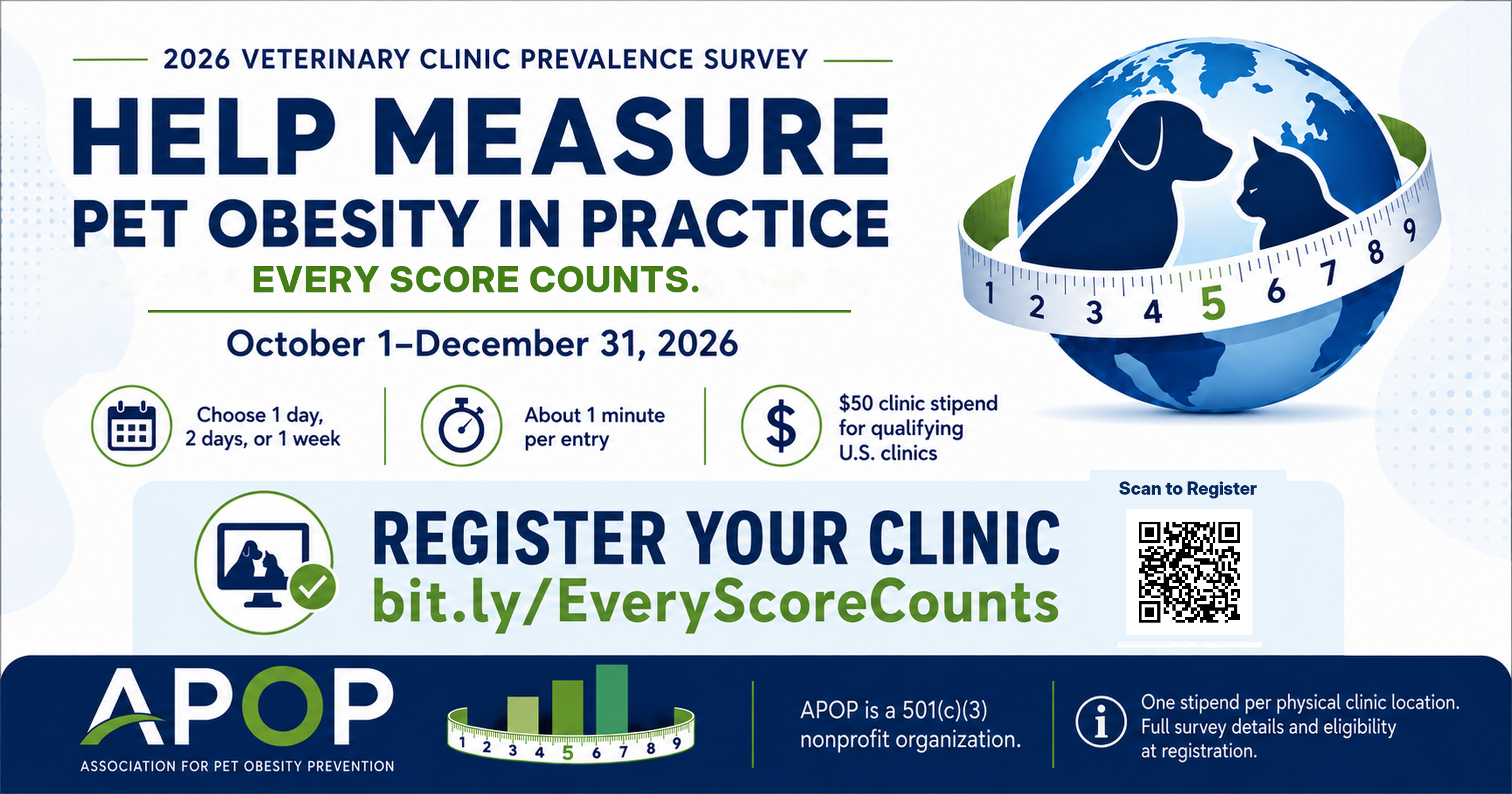
2026 Pet Obesity Prevalence Survey graphic
PNG · 2400 × 1260 px · Clinic recruitment, October 1 through December 31, 2026.
Open PNG
World Pet Obesity Month social graphic
Portrait artwork for sharing World Pet Obesity Month in social media posts.
PNG · 4:5 portrait · 2,160 × 2,700 pixels. Credit: Association for Pet Obesity Prevention.
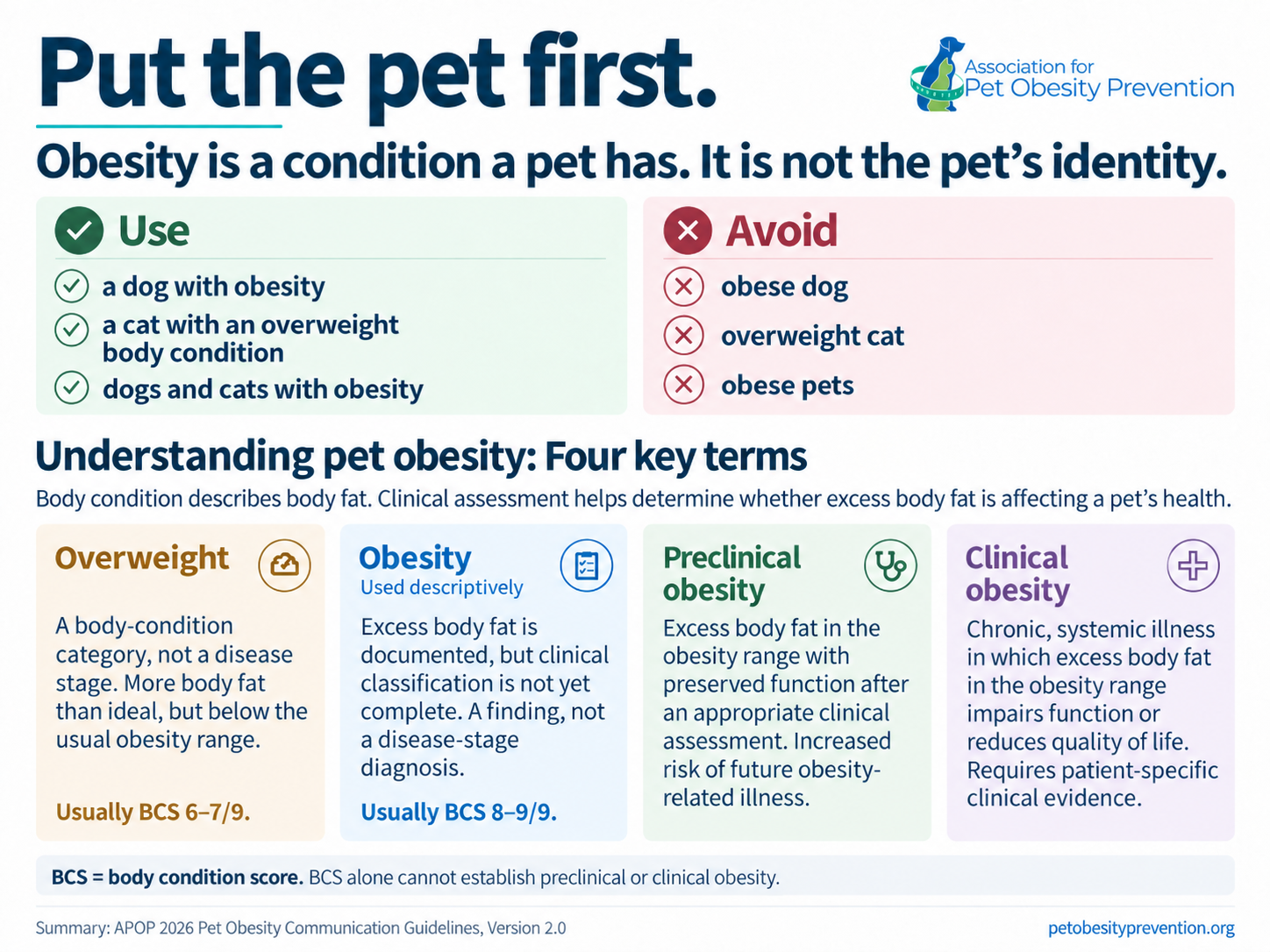
Put the Pet First
Pet-first language examples and four key terms for body condition and obesity in dogs and cats. Open the full-size image to read or save it.
PNG · Summary of the 2026 Pet Obesity Communication Guidelines, Version 2.0. Credit: Association for Pet Obesity Prevention.
-
Open PNG
 APOP logoPNG · Horizontal organization logo
-
Guidelines and social graphicsFind the four terms and ready-to-post images on the 2026 Guidelines page.View graphics
Campaign materials
World Pet Obesity Month posters for exam rooms, reception areas and digital sharing. Choose a PDF for printing or a PNG for digital use.
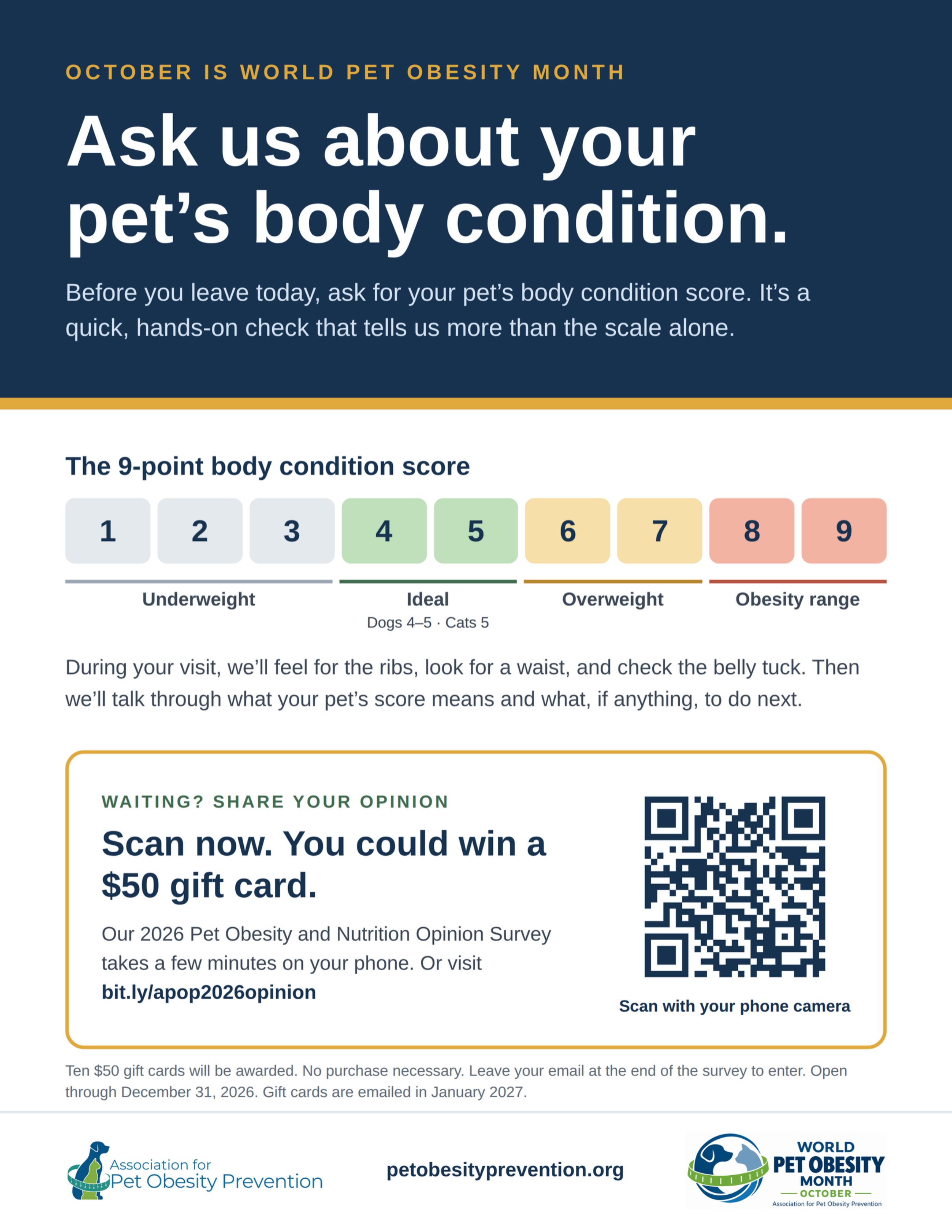
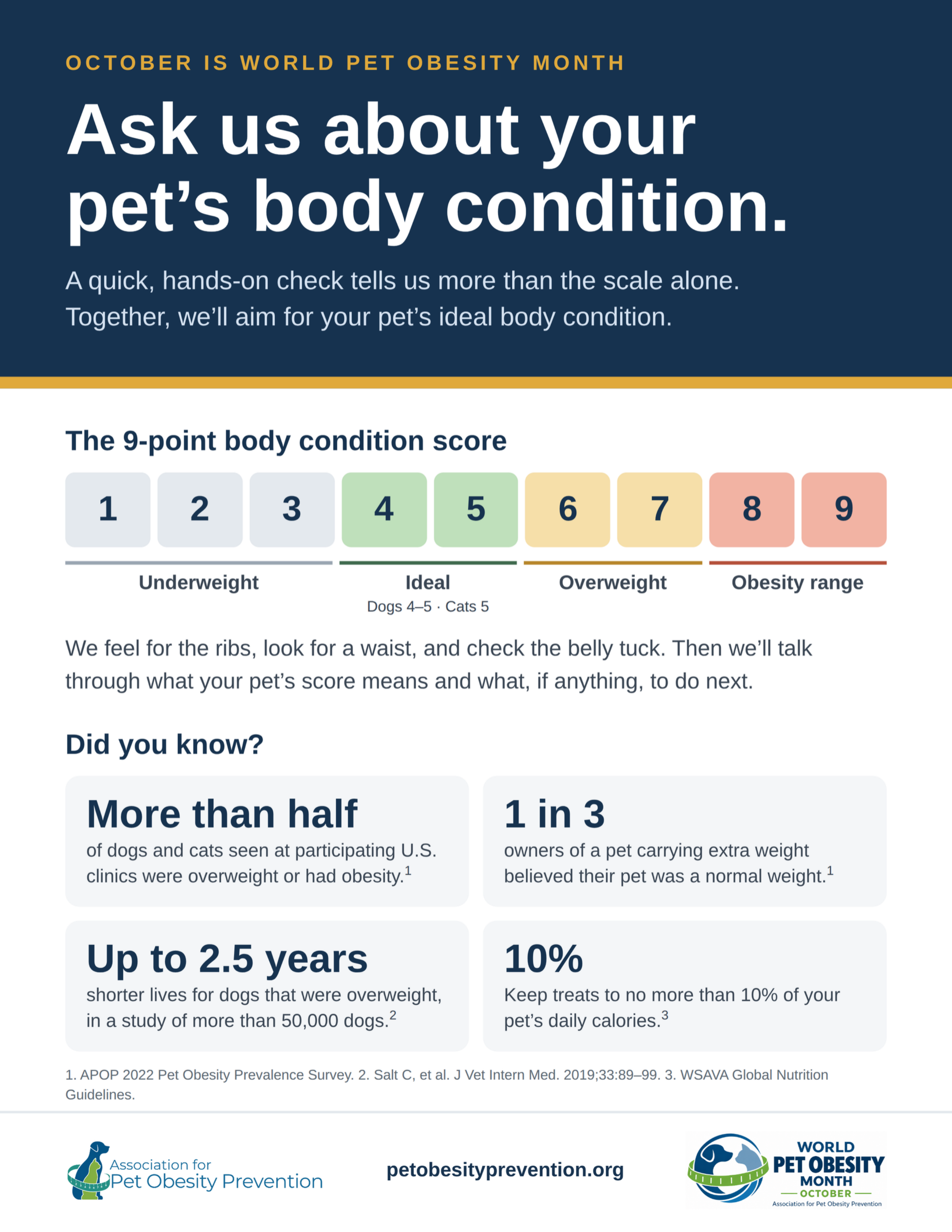
Files open in a new tab. Use your browser's save or print controls to keep a copy. Keep the supplied wording, APOP logo and credits intact.
The survey graphic is also available in the APOP Survey Partner Toolkit.
Questions for reporters
Short answers for campaign coverage, with links to the underlying findings and guidance.
What is body condition, and how is it different from weight?
Body weight is the total measured on a scale. A body condition score, or BCS, estimates body fat through sight and touch, including the ribs, waist and abdominal profile; muscle condition is assessed separately (Cline et al., 2021).
APOP’s Pet Obesity Prevalence Survey uses a nine-point scale: 4–5/9 is the ideal range, 6–7/9 the overweight range and 8–9/9 the obesity range. The veterinary team assesses the individual pet; the score is not itself a diagnosis of clinical obesity (APOP methods; 2026 definitions).
What is pet-first language?
Name the pet first and the condition second. Use “a dog with obesity” rather than “an obese dog.” For overweight, APOP’s preferred professional wording describes body condition: “a cat with an overweight body condition” or “the cat’s body condition is in the overweight range” (APOP’s 2026 Guidelines).
“Overweight cat” is not grammatically wrong; the distinction is APOP’s preferred wording, not a ban on other forms. Focus on health and function, explain contributing factors without blame, and make the next step clear. Respond to an owner’s concern rather than starting by correcting their language.
How does the 2026 Pet Obesity Prevalence Survey work?
Clinics choose one full day, two days or one week between October 1 and December 31, 2026. They record all consecutive eligible skeletally mature dogs and cats, not only pets with excess body fat, using weight, veterinary-assessed BCS and the owner’s initial impression of body condition (2026 Pet Obesity Prevalence Survey registration and protocol).
These are clinic-based surveillance findings, not a random sample of all pets. Detailed eligibility, exclusions and submission instructions are on the Pet Obesity Prevalence Survey hub.
Is 2022 still the latest published clinic prevalence data?
Yes. APOP’s latest published clinic prevalence findings are from 2022; the 2024 and 2025 Opinion Surveys report views and experiences, not newly measured clinical prevalence. Always name the survey year and population, and do not describe the 2022 figures as a 2026 national estimate (APOP survey history and methods).
What is the pet obesity perception gap?
It is the difference between an owner’s impression of a pet’s body condition and a veterinary assessment. In APOP’s 2022 Pet Obesity Prevalence Survey, 32% of owners whose pets had BCS 6–9 described their pet as normal, ideal or thin, before being told the pet’s current weight or BCS. That is not 32% of all pet owners (2022 findings).
What can journalists say about body fat and lifespan?
A 2002 paired-feeding study followed 48 Labrador Retrievers. Dogs fed 25% less than their paired companions from puppyhood had lower body fat, a longer median lifespan and later onset of signs of chronic disease (Kealy et al., 2002).
Report the study population and comparison. This was a lifelong feeding study in one breed, not a test of weight-loss treatment in all adult pets and not a reason to tell owners to cut food by 25%.
Can I use the definitions, graphics and headshots?
The definition excerpts may be reproduced unchanged with attribution under the Guidelines’ CC BY-ND 4.0 license. Use the citation and permissions note above; contact APOP before publishing adaptations or translations.
The supplied logos, headshots and campaign graphics are available for editorial coverage of APOP and World Pet Obesity Month 2026. Keep supplied wording, marks and credits intact, and do not imply endorsement. The Guidelines license does not automatically apply to these separate media assets.
For feeding, exercise and individual weight-care guidance, visit APOP’s pet owner resources and cat weight-loss guide. These resources support, rather than replace, individual veterinary care.
Links and resources
- Print or share World Pet Obesity Month posters
- Open the Put the Pet First graphic
- Read the 2026 Communication Guidelines
- Download the Guidelines PDF
- Register your clinic
- Visit the 2026 Pet Obesity Prevalence Survey hub
- Open the Survey Partner Toolkit
- Take the 2026 Pet Obesity and Nutrition Opinion Survey
- Explore APOP research and survey results
- View body and muscle condition charts
- Explore pet owner resources
- Use the pet weight and calorie calculators
- Instagram: @pet_obesity_prevention_org
- Facebook: @PetObesityPrevention
- LinkedIn: Association for Pet Obesity Prevention
Thank you to our sponsors
APOP’s research, education, and free resources are made possible in part through the support of our sponsors and partners.